
Tom Lehrer Set The Periodic Table of Elements to Music—And It Worked
This musical Ivy Leaguer made a song out of a scientific building block.

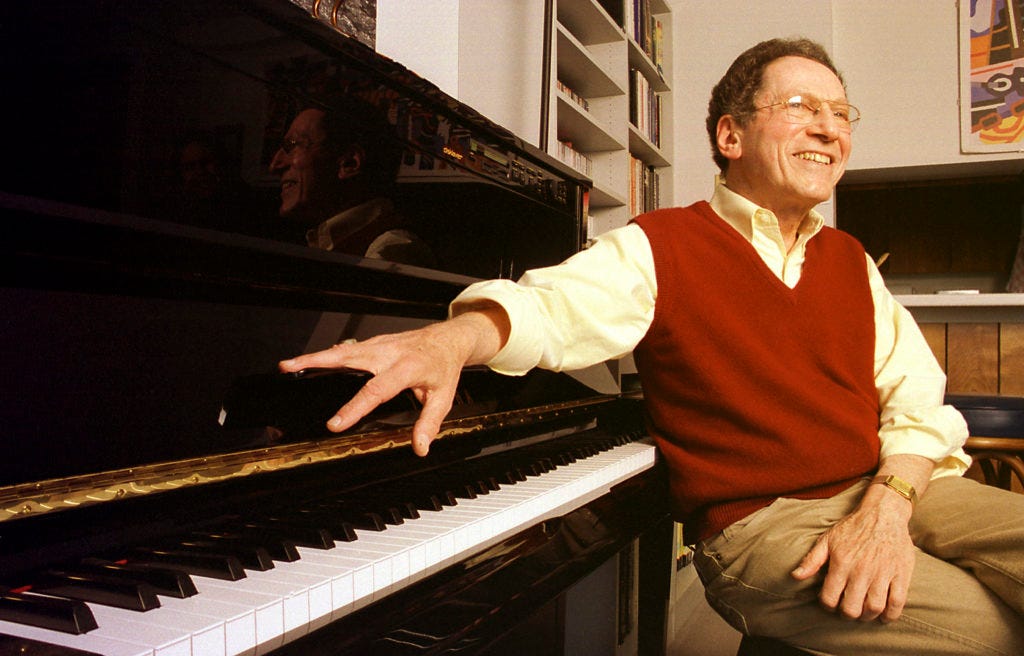
Last July, Tom Lehrer died at the age of 97. For much of his life, he was a teacher, of math and musical theater, but people knew him best for his satirical music, often about current events but mainly about things one first learns in the classroom.
Who would imagine, for example, that someone, anyone, would take the periodic table of elements and put it to the music from a world-renowned opera?
Learning through music
I don’t remember learning through music in school, but there must’ve been times. Television, on occasion, was a decent teacher.
Every Gen-Xer who grew up with Saturday morning cartoons remembers Schoolhouse Rock, a series of animated music videos that taught math, science, history and other classroom subjects. It’s probable anyone between forty and sixty can still sing the preamble to the Constitution, with few slips.
Public television, of course, had Sesame Street and The Electric Company. The former is still going strong, but the seventies and eighties may have been the peak time for both these children’s shows. Their raison d’etre was to teach, and music was often their means. Lehrer wrote ten songs for The Electric Company.
Another musical egghead, Brian May of the band Queen, would have great success as a rock star. Lehrer, however, came along when folk music was taking root. Indeed, his songs had a left-wing political bent, though he denied being anything other than a funnyman. Touring to promote his records was ultimately not for him.
Academia was more his speed.
Tom Lehrer’s education
At eight Lehrer took classical piano lessons. In time his parents found him a different teacher, who let him play show tunes, which led to him writing songs of his own. In a remarkable coincidence, as a summer camp counselor, one of his kids was Stephen Sondheim.
Lehrer skipped two grades and graduated high school at fifteen. He went to Harvard College, where he continued writing songs. He graduated at eighteen with a BA in mathematics and went on to gain an MA. In the doctoral program, he’d hold teaching appointments not only at Harvard, but MIT and Wellesley.
In 1950 he performed at Harvard functions. Three years later he recorded The Songs of Tom Lehrer and went on tour, interrupted by a two-year stretch in the military. The occasionally macabre nature of some of his songs tended to limit his audience to those who got his humor.
He believed funny songs could only educate so much:
The very nature of satire is that you have to exaggerate to be funny. If you just said “this, but on the other hand that, but nevertheless this” then it wouldn’t be funny…. To make [listeners] laugh they have to be somehow insulated and believe that the target is other people, not them. It’s mostly about them, whoever the “them” are.
In 1959 he put out another record, An Evening Wasted with Tom Lehrer.
This was where “The Elements” appeared.
About the periodic table of elements
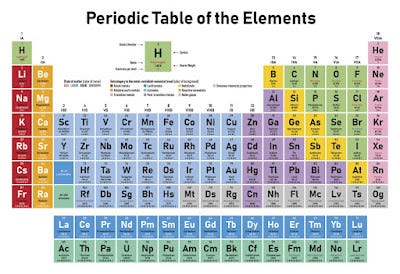
A chemical element is defined by however many protons it has within its atom. The Table arranges the elements numerically. Russian chemist Dmitri Mendeleev first put the Table together in 1869. It summarizes what each element is made of, which lets chemists determine relationships between them and predict possible new ones.
As of 2016, 118 elements have been confirmed. The last one is oganesson, first synthesized by a team of Russian and American scientists working in Russia, in 2006. It’s named for nuclear physicist Yuri Oganessian.
Here’s a scholastic rendering of the Table, which should make it easier to comprehend.
“The Elements” and Lehrer in concert
Wasted was recorded live at Harvard’s Sanders Theater on March 20-21, 1959. The album also includes songs like “Poisoning Pigeons in the Park,” based on an actual practice to limit the pigeon population in Boston parks; and “Oedipus Rex,” a ragtime number about Freudian psychoanalysis.
“The Elements” was set to the tune of the “Major-General’s Song” from The Pirates of Penzance, a lyrically complex song to begin with, not to mention the effort it takes to sing it. Lehrer’s song is also inspired by an Ira Gershwin tune about Russian composers.
At the time, the Table contained 102 elements. Lehrer, in his possibly tongue-in-cheek introduction, calls the song “completely pointless.” He also briefly puts on a New England accent to rhyme “Harvard” with “discovered.” Later, he wrote an updated version with all 118 elements and even an “Aristotle version” with what was known as the “classical” elements: earth, air, fire and water.
In 2022, Lehrer relinquished the rights to his entire musical catalog.
In the end, abandoning music in favor of teaching wasn’t a difficult decision for him.
When I got a funny idea for a song, I wrote it. And if I didn’t, I didn’t. I wasn’t like a real writer who would sit down and put a piece of paper in the typewriter. And when I quit writing, I just quit…. It wasn’t like I had writer’s block.
———
Do you remember Tom Lehrer? Leave me a comment and let me know!
Share if you liked this post
⬇️
Loved Tom Lehrer and remember the Elements song. Thanks for posting this.